Ancient Albanus – The Alban Hills
Landscape of Leisure and Revelation
A day’s journey from Rome, the Alban Hills became the preferred escape of the aristocracy. Luxurious villas crowned the slopes, including estates of Pompey and Claudius, later absorbed into imperial property. Domitian spent much of his youth here, expanding his villa over the site of Alba Longa, while the Alban Lake served as a playground for imperial barges, as it had for Caligula and Nero. The hills offered scenic beauty, private gardens, and a space where Rome’s elite could rest, play, and display their wealth.
Domitian was incapable of exertion and seldom went about the city on foot (…) There are many who have more than once seen him slay a hundred wild beasts of different kinds on his Alban estate, and purposely kill some of them with two successive shots in such a way that the arrows gave the effect of horns (…) Sometimes he would have a slave stand at a distance and hold out the palm of his right hand for a mark, with the fingers spread; then he directed his arrows with such accuracy that they passed harmlessly between the fingers.
Suetonius, The Lives of the Caesars: Domitian. Translation by Robert Graves (1957).
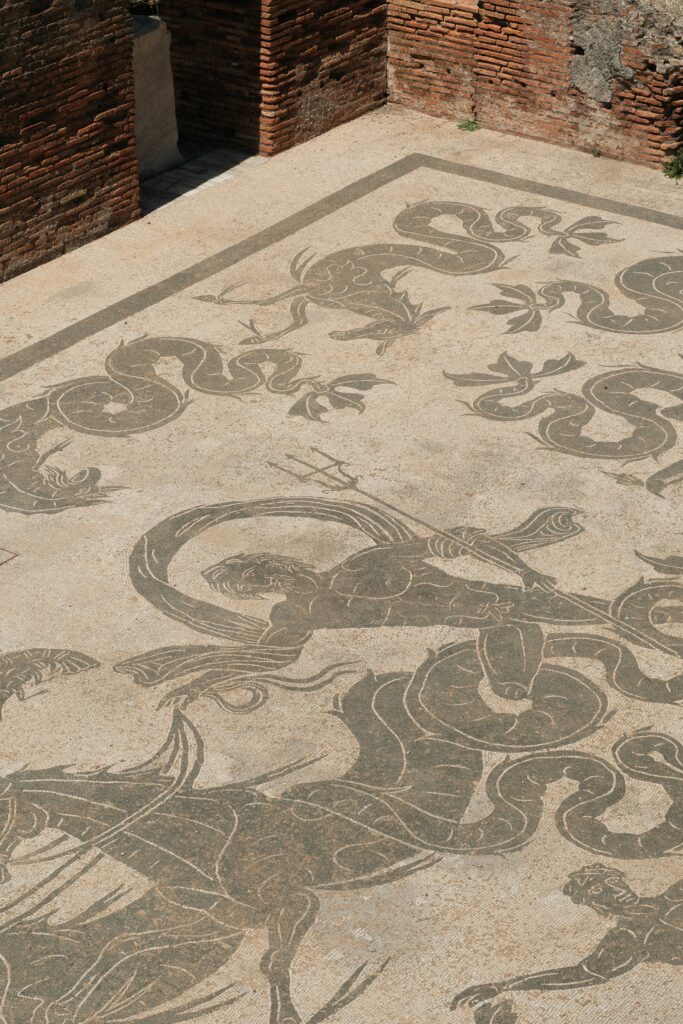
The Alban Hills were not only a place of aristocratic retreat, but also a stage for the voice of the gods. Livy describes how in the days of King Tullus Hostilius, stones rained upon the sacred mount and a mighty voice from the grove commanded the restoration of forgotten rites. Some time later, as Rome struggled against the Veii, its powerful Etruscan rival, the waters of the Alban Lake swelled without cause — a prodigy that had to be mastered before victory was possible. In this case, the landscape itself became the messenger of divine will.
At this time it was reported to the king and the senate that there had been a shower of stones on the Alban Mount. […] In their sight there fell from the sky, like hail-stones which the wind piles in drifts upon the ground, a shower of pebbles. They thought too that they heard a mighty voice issuing from the grove on the mountain-top, which commanded the Albans to celebrate, according to the fashion of their fathers, the sacrifices […] they had given over to oblivion.
Livy, The History of Rome, Book 1, Chapter 31. Trans by Rev. Canon Roberts (1927).
At this time a prodigy occurred, which was deemed important enough to interrupt the war. The Alban Lake, without any apparent cause, […] rose to an unusual height, […] flooding the surrounding fields. […] An old man of Veii declared in a prophetic strain that until the water should be drawn off from the Alban Lake the Romans never could take Veii.
Livy, The History of Rome, Book 5, Chapter 15. Trans by Rev. Canon Roberts (1927).

Modern Albanus – The Alban Hills
New Palaces on Old Hills
The company has gone to bed, but I am still writing, dipping into a shell full of India ink that has been used for drawing. We have had a few beautiful, rain-free days here, warm and friendly sunshine, almost like summer. The district is very pleasant, the town is situated on a hill, or rather, on a mountainside, and every step offers the sketcher the most magnificent subjects. The view is unlimited, one sees Rome lying there, and the sea beyond it, the mountains of Tivoli to the right side, and so on. In this cheerful region the country houses are truly designed for pleasure, and just as the ancient Romans formerly had their villas here, so for over a hundred years rich and haughty Romans have also established theirs on the most beautiful spots. We have already been walking around here for two days, and there is always something new and charming.
Johann Wolfgang von Goethe, Italian Journey (1816).
Above, Goethe is describing his time spent in Frascati, a town in the Alban Hills, during his travels around Italy between 1786 and 1788. He was staying in the town of Frascati, remarking that the
hills have remained a favoured location for the villas of the wealthy since Roman times.
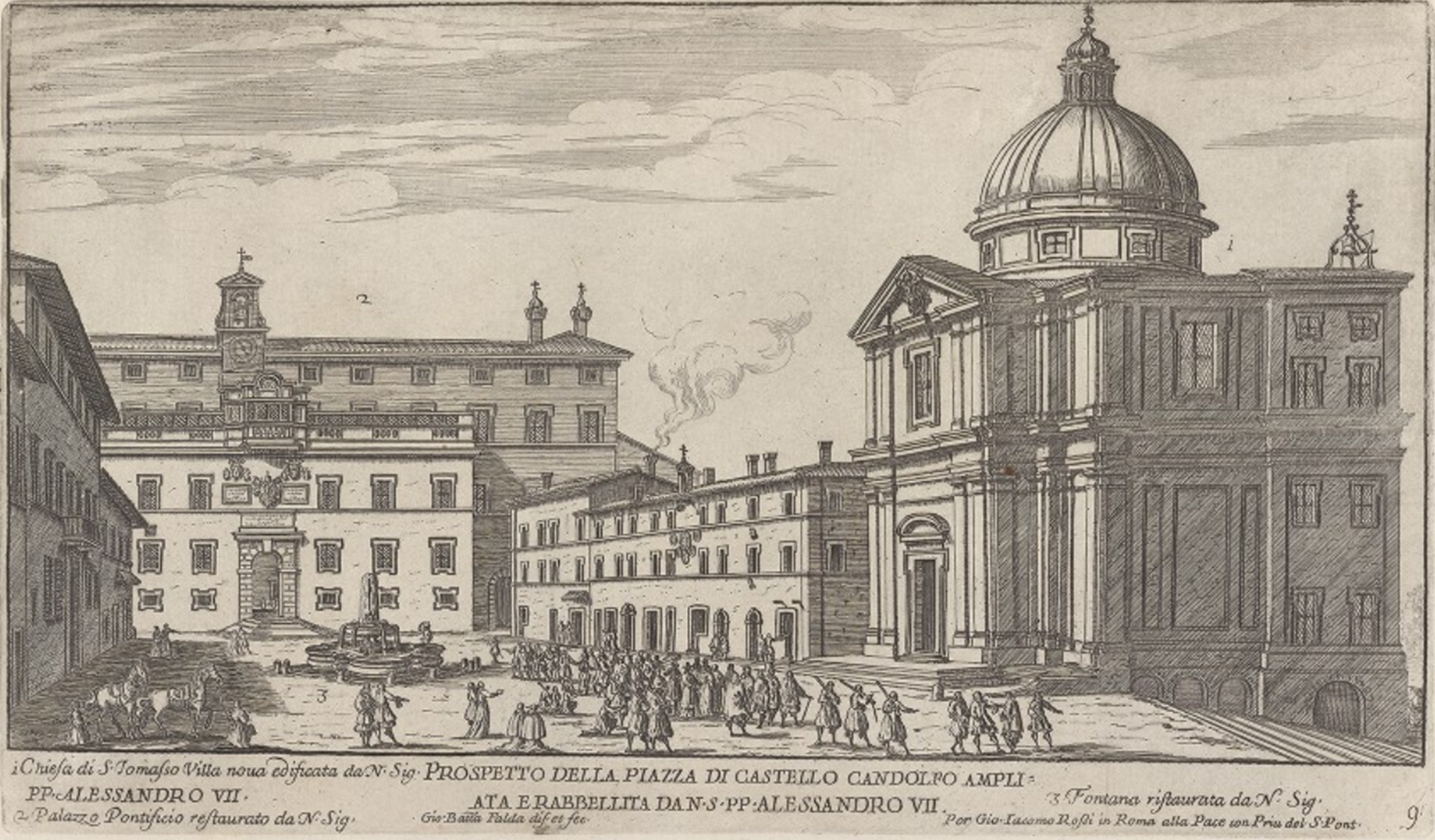
Situated on a hilltop, the Papal Palace of Castel Gandolfo served for centuries as the official summer residence of the Pope, after the principal villa was constructed in the seventeenth century. It was built on the site of a medieval castle, with the estate also encompassing the remains of Domitian’s villa.


Since the fifteenth century, numerous attempts had been made to retrieve the gigantic pleasure barges constructed by the emperor Caligula from Lake Nemi, one of the two lakes in the Alban Hills. It wasn’t until 1929 that a programme to drain the lake, initiated by Mussolini’s fascist government, was able to recover the remains of the first ship, with the second emerging in 1931. They were subsequently displayed in a purposebuilt museum, only to be destroyed by fire just a decade later, during the Second World War.
Ancient Vesuvius
When Vesuvius Shook the Roman World
This is Vesuvius, green once with vine-clad slopes,
where noble grapes once pressed the soaking vats;
the hills beloved of Bacchus beyond Nysa’s vale,
where satyrs lately danced their wild choral rites.
This was the seat of Venus, dearer than Sparta;
this place bore the famous name of Hercules.
All now lies buried in flame and sad ash;
even the gods would wish they had not the power to do this.
Martial, Epigrams, Book 4, Epigram 44 Translation by D. R. Shackleton Bailey (1993)
Before 79 AD, the slopes of Vesuvius were a paradise. Wealthy Romans built lavish villas on its fertile flanks, surrounded by vineyards heavy with grapes and orchards bursting with fruit. The mountain was sacred to the gods, a place of beauty, myth, and ritual. Martial’s words still capture its splendour. But on the night of August 24, 79 AD, the sky turned to fire, darkness swallowed the land, and the Roman world changed forever…

Broad sheets of flame were lighting up many parts of Vesuvius […] The buildings were being rocked by a series of strong tremors […] Ashes were already falling […] a dense black cloud was coming up behind us, spreading over the earth like a flood […] We had scarcely sat down when a darkness came that was not like a moonless or cloudy night […] You could hear women lamenting, children crying, men shouting […] some prayed for death […] many raised their hands to the gods, and even more believed that there were no gods any longer and that this was one last unending night for the world.
Translation by Betty Radice, Pliny the Younger, Epistulae VI.16 & VI.20
The eruption of Vesuvius claimed an estimated 16,000 lives, obliterating Pompeii, Herculaneum, and surrounding towns. Forests were flattened, rivers choked with debris, and fertile land transformed by layers of volcanic material. The region’s economy was shattered, and despite Emperor Titus’s relief efforts, the once-thriving area remained largely abandoned, leaving a lasting imprint on Roman society.

Modern Vesuvius
Rebirth from Destruction: Vesuvius in Modern Italy
The eruption of 1631, occurring from mid December to late January, was the most severe eruption since 1139. This event marked the beginning of the 1631-1944 eruptive cycle, a period of renewed and continuous volcanic activity.
By the eighteenth century, popular perceptions of Naples were deeply linked to the landscape of the region, with Vesuvius becoming the foremost feature of interest in the Neapolitan landscape. Naples was a wild and exotic place, embedded in its classical heritage and subject to the physical forces of nature. Aristocrats from throughout Europe would flock to Naples, desiring to make the journey to Vesuvius’ summit, and to observe an eruption as part of a developing scientific tradition.
William Hamilton, who served as the British envoy to the Kingdom of Naples from 1764 to 1800, became a leading expert in volcanology during his time there. In 1776, he published the volume Campi Phlegraei- a collection of his letters to the Royal Society, alongside complementary illustrations by the Italian artist Pietro Fabris.
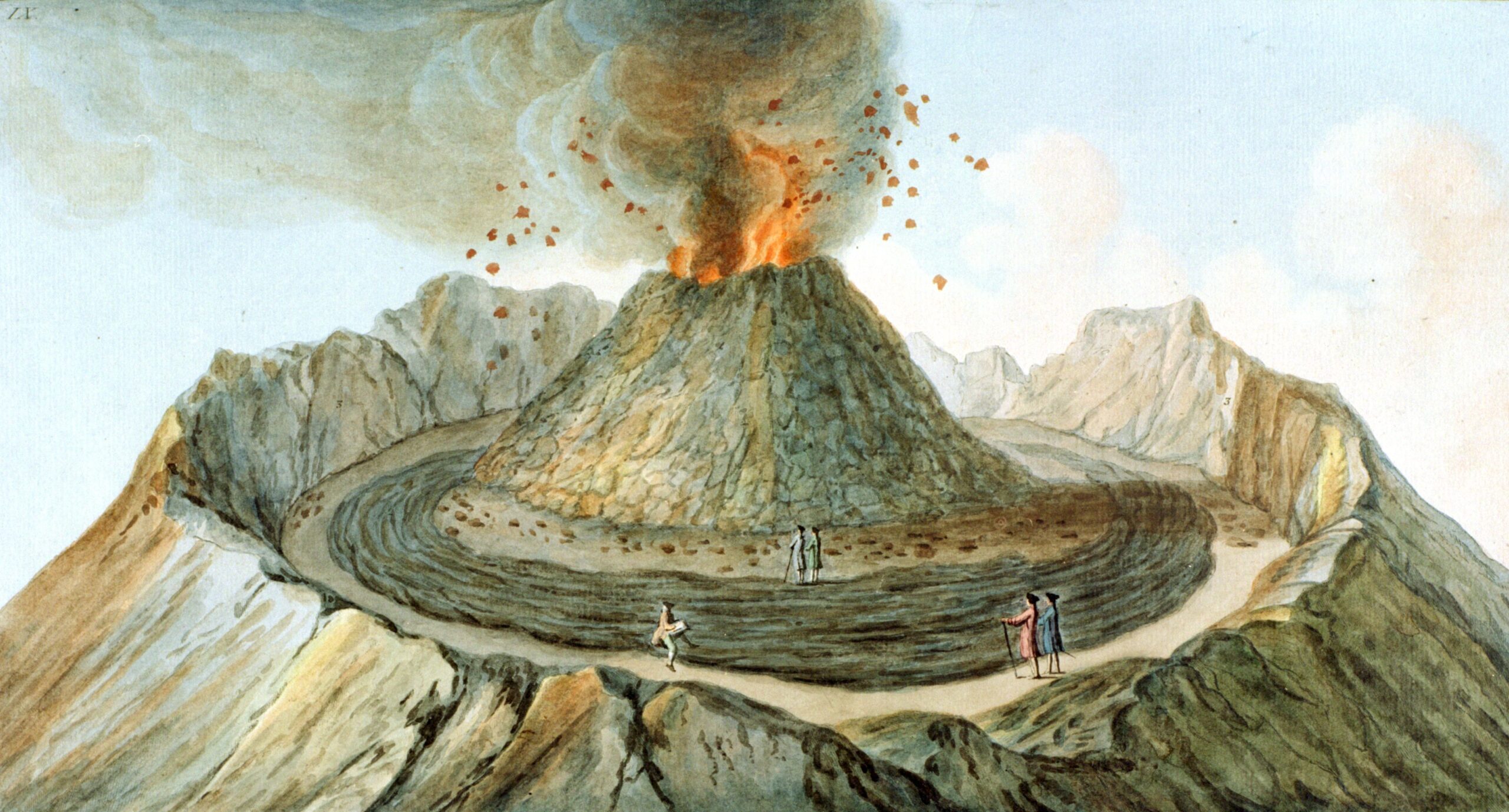
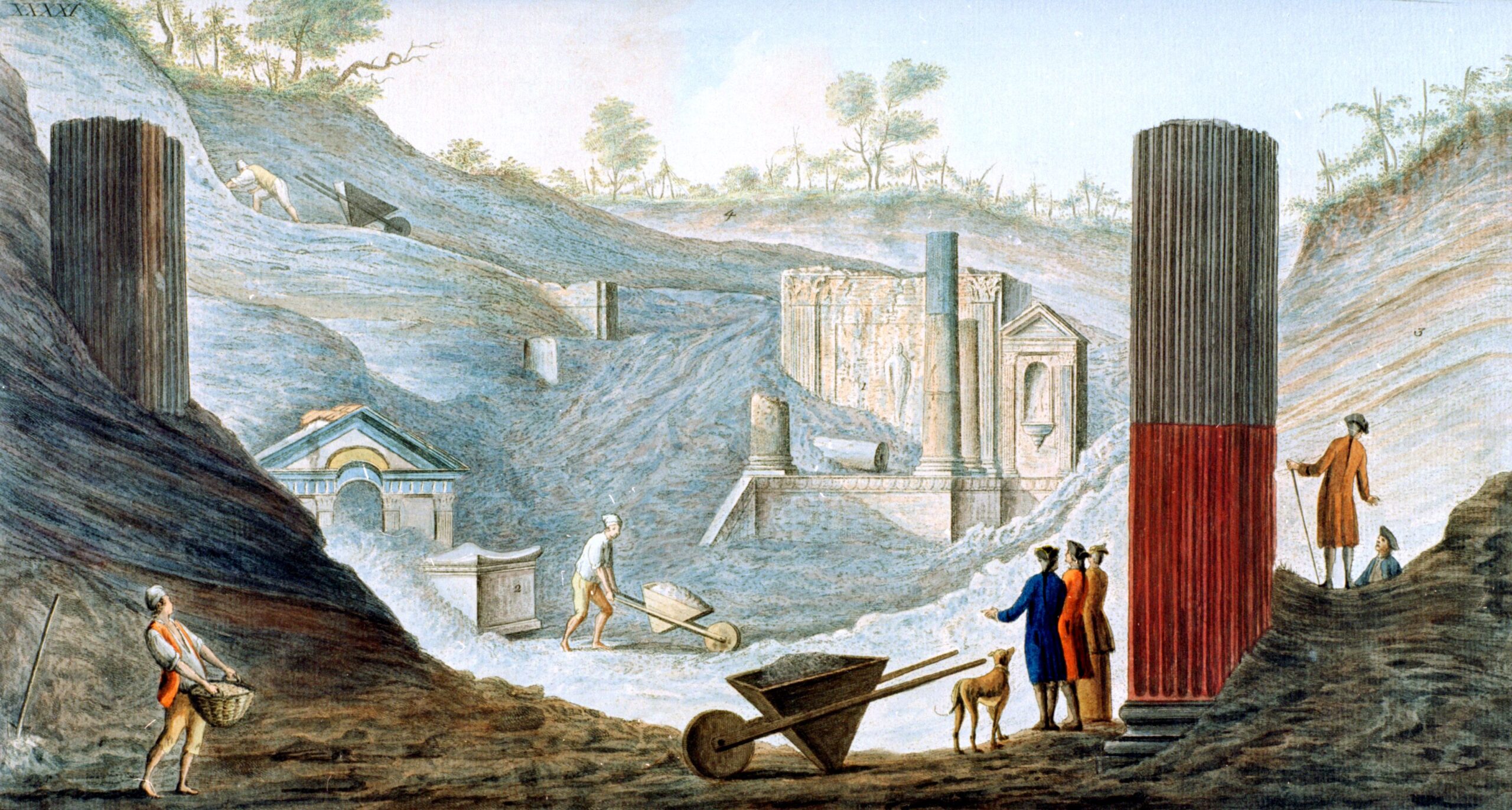
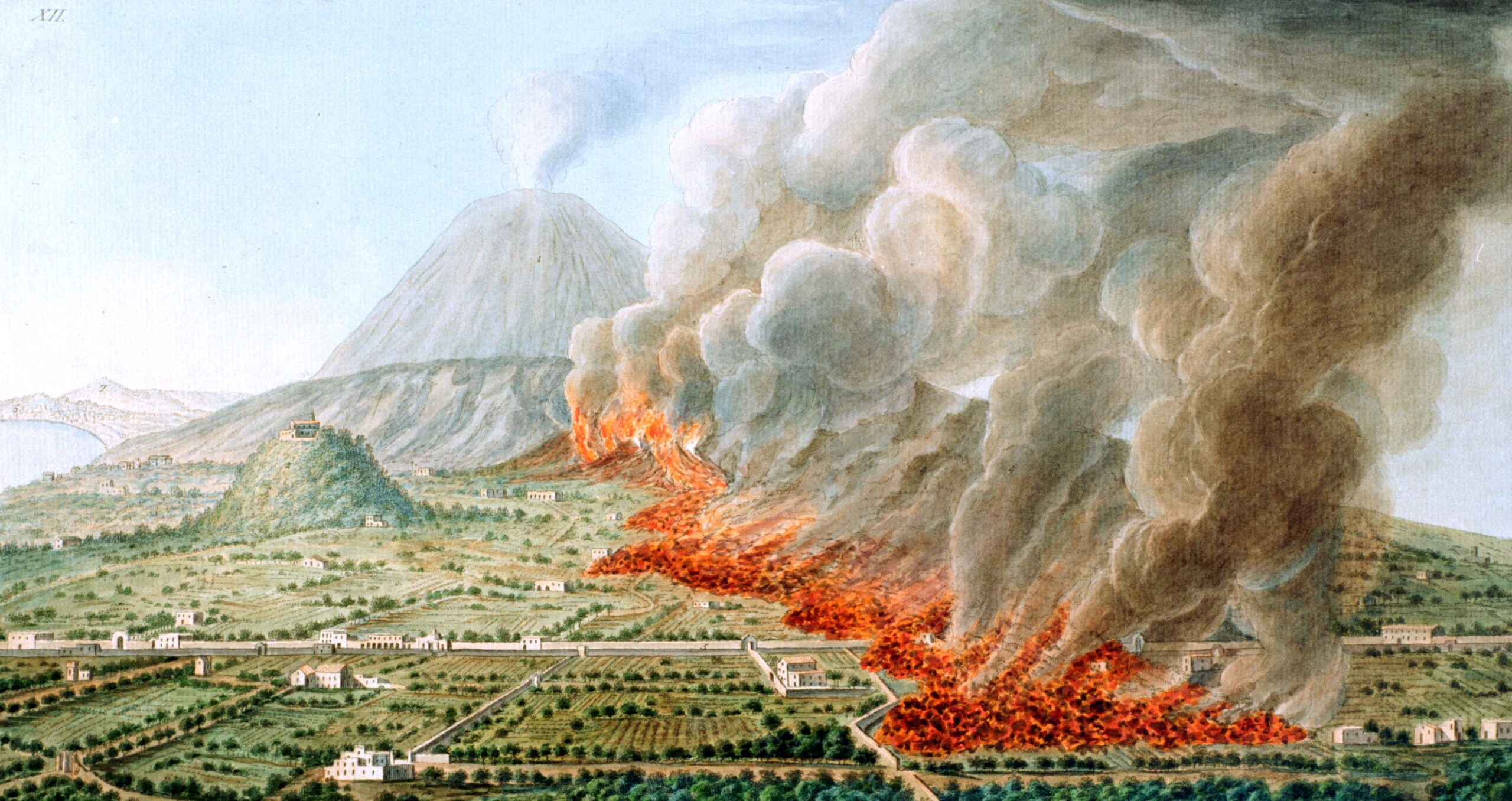
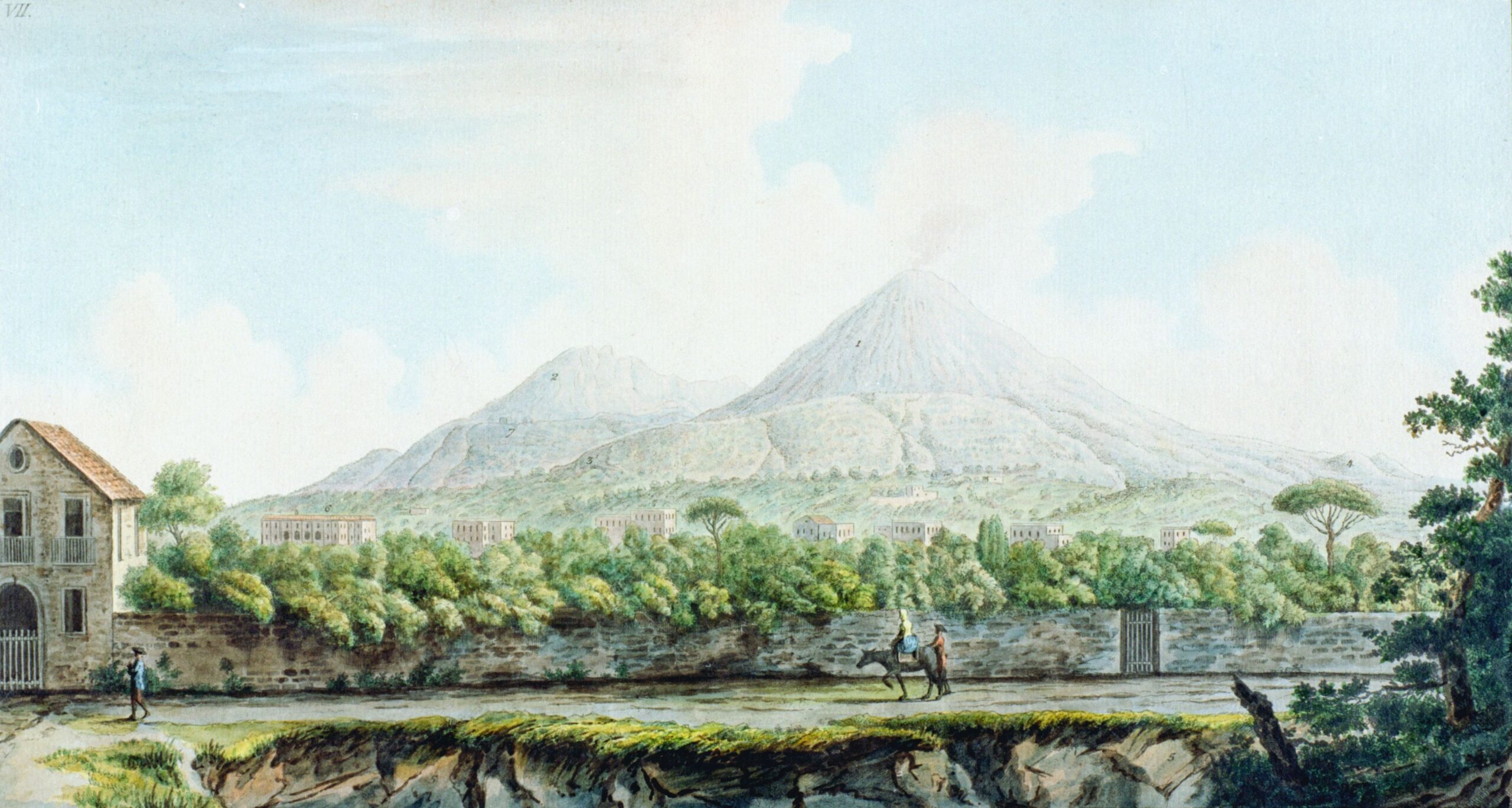
“From the top of the little mountain issued a thick black smoke, so thick that it seemed to have difficulty in forcing its way out; cloud after cloud mounted with a hasty spiral motion, and every minute a volley of great stones were shot up to an immense height in the midst of these clouds; by degrees, the smoke took the exact shape of a huge pine tree, such as Pliny the Younger described in his letter to Tacitus”
A letter by William Hamilton to the Royal Society, providing a firsthand account of the October 1967 eruption.
Here, upon the arid back
of the formidable mountain,
destroying Vesuvius,
These fields strewn
with barren ashes and covered
with petrified lava,
[…] there were joyful villas and cultivated fields,
and golden wheat fields […]
which the proud mountain
destroyed from its fiery mouth.
Yet you scatter your solitary bushes,
fragrant broom, content with deserts,
lover of sad places and abandoned by the world,
ever companion to afflicted fortunes.
Where you sit, oh gentle flower,
you send to the sky a most sweet scent,
that consoles the desert.
“La Ginestra, o il fiore del deserto” in Jonathan Galassi, Giacomo Leopardi: Selected Poems (Farrar, Straus and Giroux, 2007).
Giacomo Leopardi was one of Italy’s greatest poets and thinkers, born in 1798 in Recanati. Sickly and confined for much of his life, he developed a deep awareness of human fragility, solitude, and the power of nature. In 1836, during his last year in Naples and only a year before his death, he wrote La Ginestra, o il fiore del deserto on the slopes of Vesuvius.
The volcano is a reminder of destruction, of the cities andlives it once buried under fire and ash. Against this desolation, Leopardi noticed the broom flower, growing where nothing else survived. For him, the flower was more than a plant of the desert: it was a mirror of his own life, marked by fragility and disappointment, yet still enduring. The broom becomes a symbol of dignity and resilience, of life that continues to blossom even when surrounded by ruin.
Ancient Parnassus
The Holy of Holies: Mount Parnassus and the Delphic Oracle
Mount Parnassus was a sacred landscape. For over a thousand years it was home to the Delphic Oracle, a prophetess named the Pythia who was known to directly commune with the god Apollo. The oracle’s prophecies held great weight in the Greek world, often playing a decisive role in relations between city states, as well as the politics and power struggles within the city itself.
I can count the sands, and I can measure the ocean;
I have ears for the silent, and know what the dumb man meaneth;
Lo! on my sense there striketh the smell of a shell‑covered tortoise,
Boiling now on a fire, with the flesh of a lamb, in a cauldron –
Brass is the vessel below, and brass the cover above it.
Herodotus, Histories, I.47-48 (translated by George Rawlinson).
According to Herodotus, this was the prophecy spoken by the Delphic Oracle when called upon by Croesus, the king of the Lydians. Croesus had sent envoys to various oracles throughout Greece, asking them all to prophesize his activity on a given day. Only the Pythia produced an answer which satisfied him, stating correctly that he had taken a tortoise and a lamb, and boiled them together in a cauldron made of brass. He soon declared her to be the only genuine oracle in Greece.
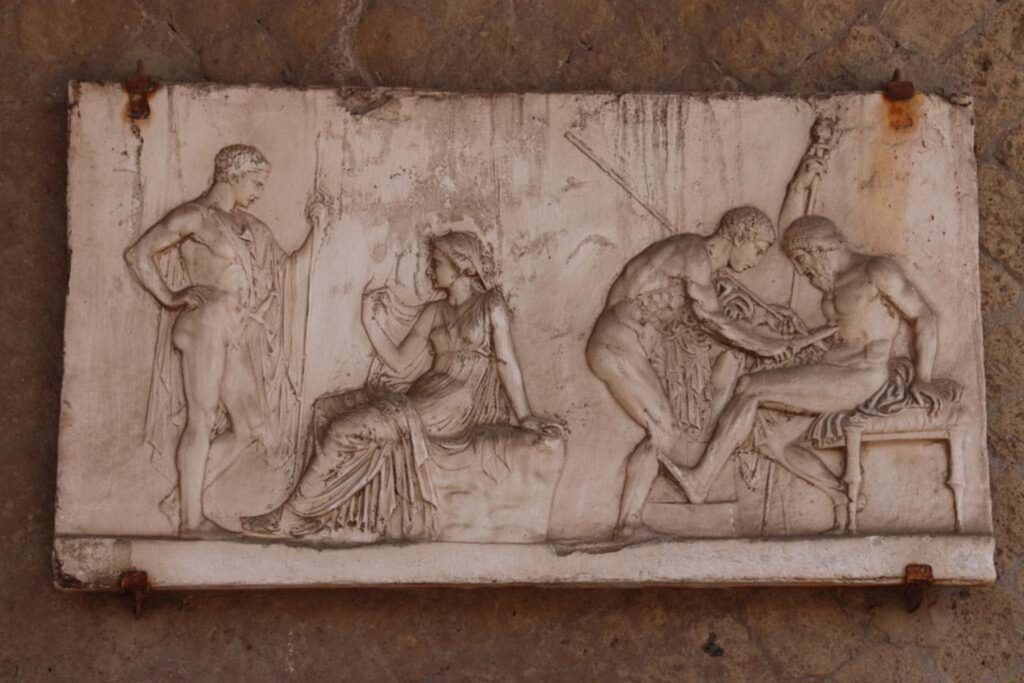
A marble relief from Herculaneum. On the left, Achilles is shown consulting the Delphic Oracle
It is a fact that the room in which they seat those who would consult the god is filled, not frequently or with any regularity, but as it may chance from time to time, with a delightful fragrance coming on a current of air which bears it towards the worshippers, as if its source were in the holy of holies ; and it is like the odour which the most exquisite and costly perfumes send forth. It is likely that this efflorescence is produced by warmth or some other force engendered there. If this does not seem credible, you will at least all agree that the prophetic priestess herself is subjected to differing influences, varying from time to time, which affect that, part of her soul with which the spirit of inspiration comes into association, and that she does not always keep one temperament, like a perfect concord, unchanged on every occasion.
Plutarch, De Defectu Oraculorum, 50-51 (translated by F.C Babbitt).
The ancient Greek biographer Plutarch, himself a priest at the temple of Delphi, seemed to attribute the frenzy experienced by the Pythia during a divine consult to the vapours and fragrances naturally produced within the temple. For decades, modern historians and archaeologists had dismissed these ancient accounts of vapours, finding no evidence of gases or chasms on the Parnassus site.
However, a recent geological study has argued that a concentration of volatile hydrocarbon gases in the temple of Apollo, produced by a combination of physical features unique to Parnassus, might have caused the intoxicating effects which provoked the Pythia to prophesise.
Modern Parnassus
Delphi Still Speaks: Echoes of Parnassus in a World of Crisis
Great Oracle, why are you staring at me, […]
I, Americus, the American, […]
Why are you staring at me as if I were America itself
the new Empire vaster than any in ancient days […]
And English the Latin of our days—
Great Oracle, sleeping through the centuries, Awaken now at last
And tell us how to save us from ourselves and how to survive our own rulers
who would make a plutocracy of our democracy in the Great Divide
between the rich and the poor […]
O long-silent Sybil, you of the winged dreams, Speak out from your temple
of light […]
Far-seeing Sybil, forever hidden, Come out of your cave at last And speak to
us in the poet’s voice — […]
And give us new dreams to dream, Give us new myths to live by!
Lawrence Ferlinghetti, To the Oracle at Delphi (2001).
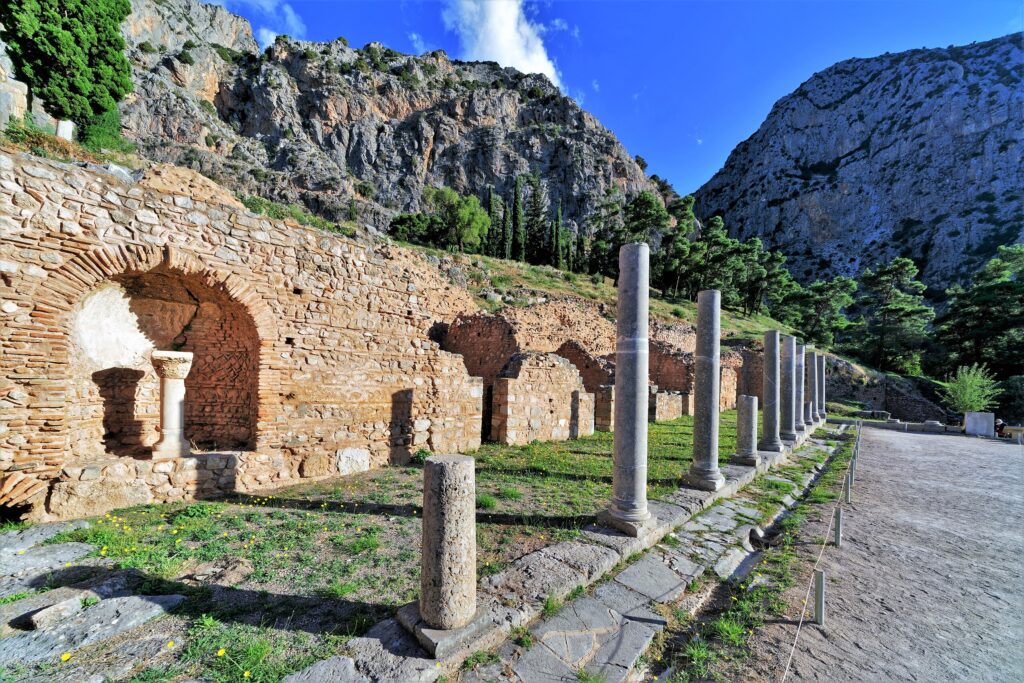
Today, Delphi is not only an ancient sanctuary but also a small Greek town of about 2,000 people, living beside its sacred ruins. In this landscape, the past is never forgotten.
Lawrence Ferlinghetti’s ‘To the Oracle at Delphi’ is a passionate poem that brings the ancient world into conversation with the political crises of the modern age. Written in 2001 and performed at Delphi during UNESCO’s World Poetry Day, it addresses the long-silent Oracle, once a symbol of divine insight and truth. Speaking as a representative of modern America, Ferlinghetti asks the Oracle to awaken and offer guidance amid global inequality, calling for the return of an ancient sense of wisdom and meaning.
Delphi remains a living symbol of cultural memory and moral reflection, a place where myth, history, and conscience converge to inspire thought and action in the present.
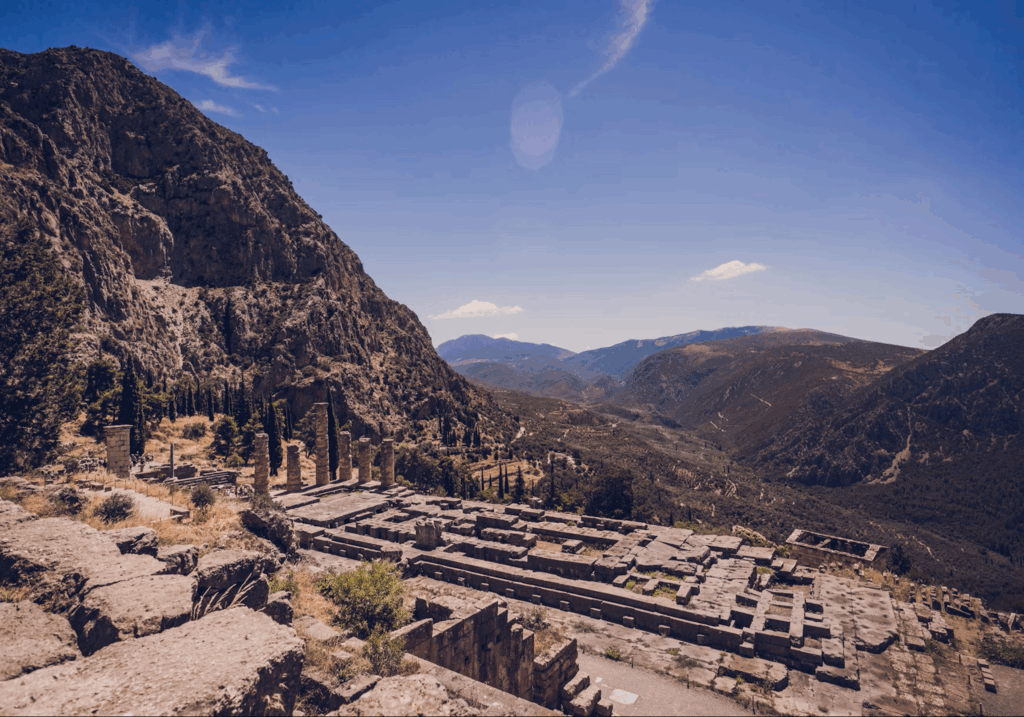
It was to Delphi and its oracle that people all over the ancient world came […] to receive wisdom on how to respond. Fast forward two-and-a-half millennia […] and we all clearly saw, here, very close to Delphi again, a warning. A warning of the future that could be in store if we do not all listen and respond.[…] We have made fighting the consequences of climate change—both on the mitigation and on the adaptation front—an absolute priority. Extreme temperatures, heavy rainfall, rising sea levels, erosion, severe weather events […] These are threats that have major impact, not just on the monuments themselves, but also on the environment, on the landscape, on the local communities that support the preservation of these sites.[…] Only through showing respect for our natural habitat can the works of humans survive through the centuries. Delphi essentially is an ark. At the same time, it is a compass that transcends human values, guiding us towards a more sustainable future.
Kyriakos Mitsotakis’ speech at “The Next 50: The Future of World Heritage in Challenging Times” in Delphi, November 17, 2022.
Delphi, a UNESCO World Heritage Site, is alive with history, drawing over a million visitors each year to its temples, theatre, and treasuries. Yet the city and its monuments face the harsh realities of climate change: wildfires, droughts, and extreme weather are increasingly threatening both the landscape and the communities that call it home, with the 2025 wildfire season proving especially severe. On November 17, 2022, the current Greek Prime Minister, Kyriakos Mitsotakis, spoke at a conference in Delphi, arguing that protecting cultural heritage means confronting climate risks and supporting the people who live and maintain the landscape. Delphi stands today at the intersection of culture and the environment, a reminder that safeguarding our history crucially depends on caring for the natural world.
Ancient Kithairon
The Wild God’s Mountain: Frenzy and Rituals on Kithairon
Messenger:
Messenger: Sir, I have seen the holy Maenads, the women who ran barefoot and crazy from the city, and I wanted to report to you and Thebes what weird fantastic things, what miracles and more than miracles, these women do.
The pitiful remains lie scattered, one piece among the sharp rocks, others lying lost among the leaves in the depths of the forest. His mother, picking up his head, impaled it on her wand. […]
Leaving her sisters at the Maenad dances, she is coming here, gloating over her grisly prize. She calls upon Bacchus: he is her “fellow-huntsman,” “comrade of the chase,
the victory she carries home is her own grief.
Euripides. Bacchae. Trans. by Ian Johnston, verses 136–147, 664–669
The passages you have just read are drawn from Euripides’ tragedy The Bacchae. They summon the wild slopes of Mount Kithairon, where women abandon the city and surrender to Dionysus in a storm of ecstasy and violence. Here the mountain itself seems alive, a place where frenzy rages unchecked and the king of Thebes, Pentheus, is torn apart by his own mother, who sees not her son but a hunted beast. On Kithairon, wonder and terror are one.
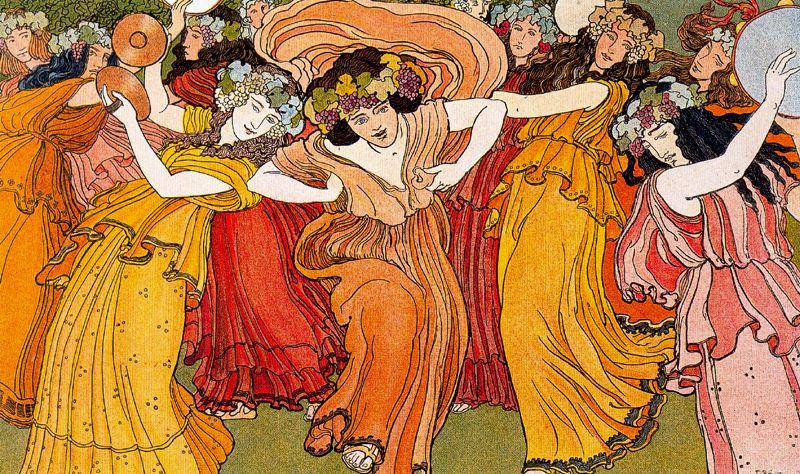
Pausanias, a 2nd-century Greek traveler and geographer, described the Great Daidala festival on Mount Kithairon in Boeotia. Every fifty-nine years, the mountain became the center of a grand ritual in which wooden statues called daidala and other offerings were burned in a massive fire. The conflagration, visible across vast distances, marked the mountain as a sacred and mystical axis, symbolizing divine reconciliation and uniting the cities in shared devotion and sacrifice.
On the peak of the mountain an altar has been prepared for them. This is how they make the altar: they fit together squared blocks of wood and put them together just as if they were building a house with stones, and having raised the altar to a great height they pile on brushwood. The cities and their magistrates each sacrifice a cow to Hera and a bull to Zeus, and burn the victims on the altar, full of wine and incense, together with the statues. [ … ] The fire seizes and destroys the altar along with them. I know of no other flame that reaches so high or is seen from so far off.
Pausanias, Description of Greece, trans. W.H.S. Jones and H.A. Ormerod, 9.3.4–8.

Modern Kithairon
A Changing Landscape: Wind Farms on Kithairon
I begin to think Actaeon never changed.
The words that followed him, the poems
That leapt upon him and left him for dead
Were difficult exactly to the extent
They were rational. It makes perfect sense
For nakedness to give way to frenzy.
And the poems, let’s be clear, were naked.
Time was, questions were put, clear as water.
The Goddess bathed, and time was the soft smile
Of water catching the sunlight on her.
And the sunlight, let’s be clear, was sheer murder.
Into the same creature, no human word
Leaps twice. Given to frenzy, nakedness
Smiles upon the breaking of men and dogs.
The Glens of Cithaeron, by Donald Revell (2016).
Without awe, without pleasure,
As a man spies on noxious beasts, he standing hidden spied
On the rabid choir of God.
They had pine-cone-tipped wands, they went half naked,
They were hoarse with insane song; foam from their mouths mingled
With wine, and sweat ran down their bodies. O fools,
Boats without oars borne on the flood of passion,
Forgetting utterly all the dignity of man, the pride of the only selfcommanding animal
…
He hear with hostile ears the hoarse and beast-like choir of the worshippers:
“O sisters, we have found an opening,
We have hewn in the stone and mortar
A wild strait gateway,
Slit eyes in the mask, sisters,
Entered the mountain.
We shall be sad tomorrow when the wine dies,
The God dies from our blood;
Today in the forest
We are fire and have found an opening.”
The Women on Cythaeron, by Robinson Jeffers (1928).
Kithairon’s status as a mythological setting has continued to enrapture poets well into the
modern era. The poems by Donald Revell and Robinson Jeffers reimagine two iconic scenes from mythology, both evoking the natural imagery of the mountain, along with the often violent and frenetic events which take place on it.
The poem by Revell reimagines the myth of Actaeon and Artemis, a hero who stumbles upon the goddess while she is bathing- and is punished by being transformed into a stag, who is then hunted by his own dogs.
Jeffers deals with the Bacchae, lingering on the moment in which Pentheus the King of Thebes discovers the women who, spurred on by Dionysus, have fled the city in a frenzy and are now calling for an entryway into the mountain.

In the present day, Kithairon’s slopes are now home to a large wind farm installed by the government of Greece. Many such windfarms are located on mountains throughout the country, as part of efforts to invest in green energy sources.
However, initiatives such as these have come under scrutiny from the Greek public, with several grassroot campaigns arguing that the wind farms are both counterproductive in challenging climate change and are having a devastating impact on local landscapes and communities.
This is just one debate in a modern Greece still grappling with the consequences of its debt crisis in 2008.